Nobody tells you that perimenopause has a skincare chapter. You hear about the hot flashes, the sleep that goes sideways, the moods that arrive uninvited. What rarely makes the list: skin that suddenly feels thinner. Redness that wasn't there last year. A jawline that seems to have quietly renegotiated its terms. If you're somewhere between your mid-thirties and early fifties and your reflection feels like it's changing faster than it used to, you're not imagining it, and it's not really about "getting older" in the vague way skincare marketing likes to gesture at. It's about one hormone leaving the building - and your skin, which has been listening to it for decades, noticing immediately.
Your skin has been listening to estrogen this whole time
Here's the part that surprises most people: skin isn't a passive bystander to hormonal change. It's an active hormonal organ in its own right, dense with estrogen receptors on keratinocytes, fibroblasts and the cells that manage pigment 1. For decades, estrogen has been quietly instructing your fibroblasts to keep producing type I and III collagen, telling your skin to hold onto elastin and hyaluronic acid, and keeping the enzymes that break collagen down (matrix metalloproteinases) in check 2. It's less a beauty hormone than a maintenance contractor. And during perimenopause, that contractor starts working fewer hours.
The numbers are more dramatic than most people expect. Research shows women can lose up to 30% of their skin's collagen content within the first five years after menopause 3, with some histological studies estimating an average decline of roughly 2.1% per postmenopausal year sustained over a 15-year period 4. Importantly, this decline tracks *menopausal age* more closely than chronological age - meaning the timeline runs on hormones, not birthdays. And perimenopause, the transitional years before periods stop altogether, is when the acceleration actually begins.

Gustav Klimt, The Three Ages of Woman, 1905
What this looks like on your face, practically speaking
Thinning and fragility
Skin thickness declines at an estimated 1.13% per year after menopause 5, and the dermis - the structural layer beneath the surface - becomes measurably less substantial. This is why skin in this life stage can start to look and feel more delicate: easier to bruise, quicker to show veins, more reactive to products it used to tolerate without complaint.
Loss of bounce, not just firmness
Elasticity - the skin's ability to snap back into place - is a different property from thickness, and it declines on its own timeline: research points to a roughly 1.5% annual decline in elasticity during early postmenopause 6. Skin becomes more extensible (it stretches) while becoming less elastic (it doesn't spring back), which is the biological reason sagging and fine crepiness tend to show up together during this window 7.
A barrier that behaves differently
Estrogen decline alters the skin's ceramide composition, one of the core building blocks of the barrier that keeps water in and irritants out 8. Combined with reduced sebum production and falling glycosaminoglycan levels, this is why skin that was never "sensitive" can suddenly start reacting to wind, fragrance, or your usual cleanser.
Slower repair
Estrogen also plays a direct role in inflammation control, tissue repair and re-epithelialization 9 - which is part of why blemishes, irritation or minor nicks seem to take longer to resolve than they used to.

Berthe Morisot, Woman at Her Toilette, 1875-80
Why this isn't just "getting older" - and why it starts earlier than you'd think
It's tempting to file all of this under general aging, but the mechanism is specifically hormonal, not purely chronological. Collagen production actually begins its slow decline from around age 25, and subtle hormonal shifts can start influencing skin well before periods become irregular - meaning some of what shows up as "my skin changed this year" in your late thirties may already be an early perimenopausal signal, not a coincidence of time passing 10.
This is precisely why skincare built around cellular and hormonal mechanisms - rather than one built around surface hydration alone - tends to matter more in this decade than in the one before it.
Where neurocosmetics enter the picture
This is also, not incidentally, where the skin-brain-hormone conversation gets interesting - and it's a topic we go into in far more depth in Glow Interrupted: how stress hijacks your skin. Chronic stress and elevated cortisol compound hormonal skin changes: cortisol interferes with the same fibroblast activity that estrogen is trying to support, and the two pathways - hormonal and neuro-endocrine - overlap directly in the skin 11. Skin under both hormonal transition *and* everyday psychological stress essentially receives a double signal to slow down collagen and hyaluronic acid production at once. This overlap is exactly why we build our neurocosmetic formulations around cortisol regulation rather than surface hydration alone.
This is the exact intersection where our formulations were built to work. Cassia Angustifolia Seed Polysaccharide, used in Skin Repair Serum, was studied specifically on female volunteers aged 35-65 - squarely our core audience - and shown to rebalance the skin's cortisol regulators (a 61% decrease in cortisol-generating activity, a 215% increase in cortisol-repressing activity), while increasing hyaluronic acid synthesis by 99% and collagen synthesis by 13%. Rhodiola Rosea Root Extract, also in Skin Repair Serum, is clinically shown to raise beta-endorphin levels in skin more than fourfold, supporting the skin's own resilience response rather than working against it. And Nephelium Leaf Extract targets dermal fiber synthesis directly - improving elasticity by 19% and reducing wrinkles by 15% in testing - working on the same collagen-and-elastin machinery that estrogen decline slows down, without asking the skin to tolerate an irritant to get there. The full ingredient dossier has the underlying data on all three, if you want to check our work.
None of this reverses a hormonal transition - no amount of serum rewrites your endocrinology. But it does mean the skin isn't left to manage two compounding stress signals, hormonal and cortisol-driven, with nothing working at the cellular level on its behalf.

Lucas Cranach the Elder, The Fountain of Youth, 1546
What's actually worth doing
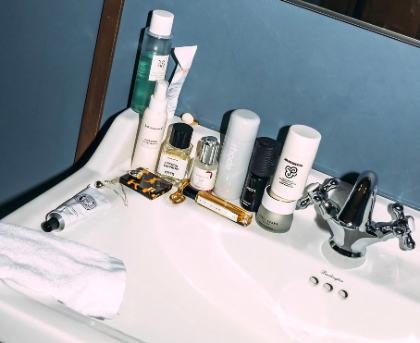
- Prioritize barrier-supportive formulas over aggressive active layering. With ceramide composition already shifting, this is not the decade for six-step acid routines. PHA EFOLIATING TONER
- Look for ingredients that work on fibroblast and collagen signaling directly. Biomimetic peptides, plant polysaccharides, tetrapeptides - rather than products that only sit on the surface.
- Don't ignore the stress side of the equation. Since cortisol and estrogen pathways overlap in skin, addressing chronic stress (sleep, breathwork, even short daily rituals) has a measurable downstream effect on how skin manages this transition.
- Talk to a doctor about hormone therapy if symptoms are significant. Topical skincare supports the skin; it is not positioned to replace medical evaluation of perimenopausal symptoms, and this article isn't intended as medical advice.
Perimenopause isn't a flaw in your skin's system. It's a predictable, well-documented shift in the instructions your skin has been receiving for years. Understanding the mechanism doesn't undo the transition - but it does mean you can stop guessing and start working with what's actually happening underneath.
Frequently asked questions
Does perimenopause actually affect skin, or is that just marketing?
Yes - and the mechanism is well-documented, not marketing. Skin has its own estrogen receptors on fibroblasts and keratinocytes, so when estrogen declines during perimenopause, skin loses the signal that maintains collagen, elastin and hyaluronic acid production directly, independent of chronological aging 12.
At what age does perimenopause start affecting the skin?
Subtle hormonal shifts can influence skin from the mid-thirties onward, well before periods become irregular. Collagen production itself starts its gradual decline from around age 25 13, which is why some women notice changes years before "perimenopause" enters the conversation with their doctor.
Can skincare reverse perimenopausal skin changes?
No topical product reverses a hormonal transition - that's a job for your endocrine system, and if symptoms are significant, a conversation with your doctor about options like hormone therapy. What skincare formulated around fibroblast and cortisol signaling can do is support the skin's own collagen and hyaluronic acid production, rather than leaving it to manage the transition alone.
Is perimenopausal skin more sensitive to stress?
Yes. Cortisol and estrogen pathways overlap directly in skin cells, so the same hormonal window that reduces estrogen's protective signaling also makes skin more reactive to everyday cortisol spikes from stress 14.
Read more:
- Managing Menopausal Skin Changes: A Narrative Review of Skin Quality Changes, Their Aesthetic Impact, and the Actual Role of Hormone Replacement Therapy in Improvement,Journal of Cosmetic Dermatology, 2025
- Managing Menopausal Skin: A Clinician's Review, European Medical Journal, 2025
- Estrogens and aging skin, Thornton MJ., Dermatoendocrinol. 2013;5(2):264-270.
- Effect of estrogens on skin aging and the potential role of SERMs, Thornton MJ., Clin Interv Aging
- Managing Menopausal Skin Changes: A Narrative Review, Viscomi et al., Journal of Cosmetic Dermatology, 2025
-
The Multidimensional Spectrum of Neurocosmetics: Aesthetic Applications and Perspectives, Rizzi, Gubitosa, Fini, Cosma; Cosmetics, 2021, 8(3), 66
*This article is for informational purposes and does not constitute medical advice. If you're experiencing significant perimenopausal symptoms, please speak with your doctor.