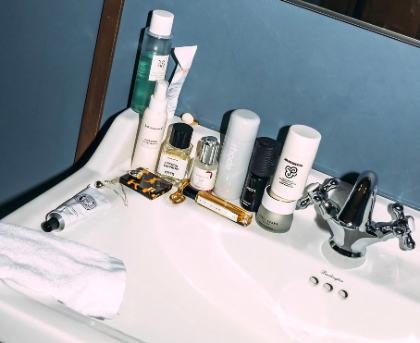
Somewhere in the last decade, "routine" started meaning ten steps and an app to remind you which serum goes before which other serum. Then skin started reacting - to the ninth product layered on the eighth, to actives meeting each other for the first time on an actual face rather than in a lab. So a majority of women quietly did what dermatologists had been recommending all along, just not as loudly as everyone else: they put half the shelf away. 63% now say they'd rather run a pared-back regime, three products or fewer. Nobody talked them into this. If anything, they had to tune out a decade of influencers and ten-step tutorials to get there - and it happens to line up with a couple of famous psychology experiments and your own exhausted 7am self, both of which nobody consulted either.
The shelf got crowded, not better
A survey of dermatologists and dermatology residents asked the obvious question: does the evidence actually back up elaborate, multi-step routines for otherwise healthy skin? Mostly, no. The same dermatologists reported seeing real complications from complex, trend-driven regimens, plus no shortage of misinformation feeding them2. Which is a nice way of saying the people who spend their careers looking at damaged skin are not, in fact, quietly rooting for your twelfth product.
Every step you add is another chance for something to go sideways - a sensitizer your skin hadn't met yet, a pH your other three steps weren't built for, two actives figuring out on your face that they don't get along. Researchers have watched this play out for years: the rise of double-cleansing, ten-step regimens and serum stacked on serum has been named directly as a contributor to rising contact dermatitis, particularly in women3. Double cleansing itself isn't the villain here - dissolving SPF and makeup before a water-based cleanser finishes the job is a perfectly reasonable thing to ask of skin. The trouble starts once nobody ever takes anything away, only adds.
It's not only about allergens, either. A 2024 clinical study on "stackable" skincare found that layering several active ingredients can irritate skin on its own terms - no single ingredient needs to be the culprit4. Which, translated out of the clinical language, means your niacinamide and your acid had a small disagreement on your face last night, and your face lost.

Kazimir Malewicz, Black square, 1915
The best serum is the one you're still using in March
Here's a finding that gets less attention than it should: the more complicated a routine gets, the less likely anyone actually sticks with it5. Not because people are careless. A nine-step regimen simply gives you nine separate chances to skip something on a busy Tuesday, and busy Tuesdays have never once lost.
Skincare marketing rarely says this part out loud, because a long ingredient list photographs better than a short one: the product that works isn't necessarily the one packed with the most actives. It's the one that's still in rotation in six months, applied correctly, without a barrier so overworked it's given up responding to anything. A stressed, over-treated barrier tends to end up worse off than one that was left to do its job with one well-chosen formula4 - a mechanism we've gone into in more detail in Barrier first.

William Hogarth, Marriage A-la-Mode: 4. The Toilette, approx. 1743
Why twelve products feel exhausting before you've even opened the third one
This next part has nothing to do with skin, which is exactly why it's convincing. In one of the more famous studies in decision psychology, people offered a small, curated set of options were more likely to actually pick something - and happier with what they picked - than people staring down a huge assortment6. It's the jam study everyone quotes at dinner parties: more jam on the table, fewer jars sold. Skincare aisles found the identical trap and climbed straight into it.
There's a second mechanism sitting underneath that one, and it's less forgiving. Decision-making draws on a resource that runs low across the day, roughly the same way willpower does7, which is the actual reason a twelve-step evening routine is the first casualty on the exact nights you needed it most. Nothing failed. You simply ran out of "make a decision" somewhere around step four, and stopped.
Then there's plain arithmetic nobody prints on the bottle. A multi-step routine can eat close to 20 minutes a day, which works out to something like five full days a year - before you've even factored in researching, ordering, and restocking a dozen separate items. 72% of people say they now feel genuinely overwhelmed by how many new products exist to choose from8, and 81% of women over 35 specifically want a simpler routine9 - which happens to be exactly who this brand exists for. There's a packaging argument too, and it doesn't need much defending: fewer bottles means less manufacturing and less landfill, and 75% of households have already voted with their actual shopping carts10.
One more benefit, rarely mentioned because it isn't glamorous: fewer products means you can actually run an experiment on your own face. Twelve things layered together, and a breakout has twelve suspects. Three things, and you stand a real chance of finding out which one is lying to you.
Multi-functional isn't a buzzword. It's the entire design brief
None of this argues for doing nothing. It argues for making every remaining step earn its place, which turns out to be a much higher bar than most products ever clear.
Fundamental Serum exists because "one moisturizer, one barrier cream, one antioxidant serum" is three jobs a single formula can do - Ceramide NP and Olive Glycerides for the barrier, Arginine and Hibiscus Sabdariffa for hydration, antioxidant protection built in rather than bolted on as a fourth step later. Skin Repair Serum does the equivalent on the neurocosmetic side: cortisol regulation, collagen support and resilience in one step, rather than three specialty serums that each handle one mechanism and ignore the other two.
The rest of the range follows the same logic - a capsule, not a catalogue. Good Morning Set and Good Evening Set exist instead of two dozen single-purpose items that only make sense applied in an order nobody remembers past week one.

François Boucher, La Toilette, 1742
What actually earns a spot on a shorter shelf
- Cleanse once, gently, and mean it - not a ritual, just a reset. Over-cleansing undoes the barrier a smaller routine is trying to protect in the first place.
- Choose one serum on purpose: barrier support, hydration and a targeted active in a single formula, rather than three bottles applied in a sequence you have to remember every morning.
- Keep sunscreen. It's the one line item skinimalism was never meant to cut - still the single highest-leverage step in skincare, minimalist or otherwise.
- Add one new thing at a time, for an actual reason, not because a video made a convincing case at 11pm - and give it several weeks before deciding whether it belongs.
- If something hasn't visibly done anything in 8-12 weeks, it isn't multi-functional. It's just taking up space.
Frequently asked questions
What is skinimalism in skincare?
A move toward simplified routines built around fewer, more effective products, instead of long regimens made of many single-purpose steps11. Part consumer fatigue with complexity, part dermatological evidence that layering many actives raises the risk of irritation4.
Is a minimalist routine actually as effective as a ten-step one?
When the products themselves are genuinely multi-functional, yes - and it can outperform a complex routine simply by causing less irritation and getting used more consistently4. More steps only help if every one of them is necessary and gets along with the others.
Why do fewer products sometimes lead to better skin?
Fewer potential sensitizers, less risk of actives interfering with each other, and a routine simple enough to actually follow through on3. Consistency does more for skin over a year than step count ever does.
What makes a serum "multi-functional" rather than just a marketing word?
It addresses more than one mechanism - barrier repair, hydration, a targeted active - within one formulation, rather than listing several benefits while a single ingredient quietly does all the work. A fair test: could it replace three single-purpose products without any one job feeling like an afterthought?
Further reading:
- Dermatologists' Perspectives on Skincare Routine Trends; Clinical, Cosmetic and Investigational Dermatology, 2026
- A review of contact dermatitis; Annals of Allergy, Asthma & Immunology, 2020
- Stackable Medical-Grade Skincare for the Cosmetic Medicine Patient: A Long-Term Pilot Assessment; Pryor S, Semersky A, Sabev T, Few J; Aesthetic Surgery Journal Open Forum, 2024
- Adherence to treatment in dermatology: Literature review; Lo, et al.; JEADV Clinical Practice, 2024
- When Choice Is Demotivating: Can One Desire Too Much of a Good Thing?; Iyengar SS, Lepper MR; Journal of Personality and Social Psychology, 2000, 79(6), 995-1006
- Can Skinimalism Catch On in an Industry That Cannot Stop Launching?; Ethos, citing Olay consumer survey
- Less is More: How Skinimalism is Redefining Beauty Routines and Packaging; NIQ 2024 report, via Global Cosmetic Industry
- Skinimalism Trend 2026: Fewer Products, More Effective; IML Testing & Research
- Assessing the Adverse Effects and Safety Concerns Related to Cosmetic and Skincare Products: A Systematic Review; Alyahya RS, AlHasson MA, Alhsaon MA Ali; Cureus, 2025
- Exploring the Impact of Skin Care Routines on the Skin Microbiome and Possible Skin Disease Risk - A Pilot Study; Dubli K, Balasundaram P, Chaudhari R, et al.; Biomedicines, 2025,
- Skin Barrier Dysfunction in Chronic Dermatoses: From Pathophysiology to Emerging Therapeutic Strategies; Espinoza Urzua I, Vidal Vidal MI, Vega Solano M, Bedoya Jaramillo JE, de la Cruz Donis GG, Romero Valverde A; Cureus, 2025
- Rates of skincare product and cosmetic procedure use in patients with acne vulgaris and the effective factors; Aslan Kayıran M, Karadağ AS, Alyamaç G, et al.; Journal of Cosmetic Dermatology, 2022