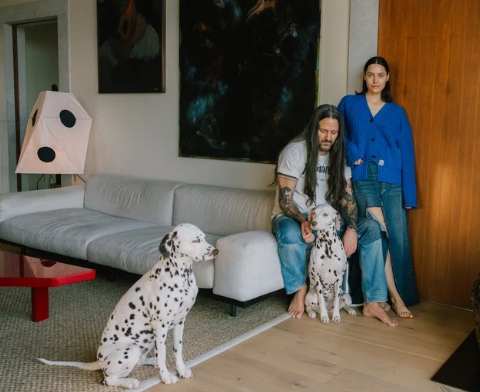
She talks about music less like a craft she controls and more like a current she moves within - one stream among many, simultaneous and largely beyond her grasp. With seven Fryderyk Awards and a European Film Award to her name, she still chooses projects that demand the most of her - not despite the difficulty, but because of it.
Sit down with your morning tea and join me on a walk through the mind of Hania Rani - pianist, composer and one of the most quietly radical voices to emerge from the classical world in the past decade - as she opens up about the slow, almost stubborn nature of her creative process, the freedom and self-esteem she found, and why she still believes that the best ideas arrive on foot, in silence, uninvited. Between long walks, cooked grains and orchestral scores that take months to finish, she shares a philosophy of making work that has less to do with productivity than with patience - and a great deal to do with staying curious.
 Photo: Asia Typek
Your artistic career has unfolded remarkably fast - within just a few years of your critically acclaimed solo debut with Esja, you were performing across the world, receiving seven Fryderyk Awards, a European Film Award... While your musical journey is well documented, what I want to explore today is something far less visible: your inner creative process and how you manage your physical self to reach such heights within the demanding reality of constant movement…
It’s really hard for me to see those achievements from a wider perspective because for 7 years now I’ve been similarly busy with my work and engaged with multiple projects at once. Although the thing that changed immensely is the amount of freedom and trust I’ve gained which allows me to be way more playful and experimental with my music and artistic endeavours. This sort of lifestyle, or let’s call it, passionately spent time, if you wish, was something that I learnt arguably from my parents, who are both extremely active people. But most likely also back at the music school, where the process of learning a new piece was counted in months, instead of days - I think this really makes you understand that complex ventures need an ample amount of time to be finished.

Photo: Hania’s family archive
I read that this sort of attitude - find a thing that you are passionate about and simply keep on doing it - is also quite common in Japanese culture, which is embedded in Zen and Buddhism, and to some extent is supposed to bring peace of mind and sense of purpose. I think there are many ways to call it, some people would call it escapism, but I assume that it definitely helped me to go through many obstacles and difficulties in my life - to find my passion and to genuinely enjoy what I’m doing. I also observed that I can only fully engage with projects that challenge or inspire me, this also became my way of selecting invitations that I want to be involved with. Even if the project seems tremendously tedious but it resonates with me and also makes me evolve as a person and artist - I say yes.
 Left: Olivia Wünsche; Right: Asia Typek
You've been playing since the age of seven - and yet your transition from performer to creator unfolded slowly, almost hesitantly. It was only during your later studies in Berlin that you described experiencing a growing, almost overwhelming sense of freedom - one that expanded what felt possible for you as a pianist and artist. What allowed you to open up then? What helped you nurture and embrace your own creativity?
I think this hesitation was sadly a result of the education system, its incompleteness. When I started playing the piano, female composers’ names were hardly mentioned. I could list from memory only two: Hildegard von Bingen and Clara Schumann, who was mostly brought up as Robert’s talented wife. Growing up in such an impoverished environment, which was a standard not only in Poland but everywhere else, I believe, definitely informed my career choices and didn’t allow me to include a composing career from the very beginning of my education.
Although I don’t think that my trajectory went all wrong, as I was lucky enough to meet marvelous teachers and academics, who inspired me to engage with music on a professional level and simultaneously allowed me to achieve comprehensive understanding of my instrument but also music history and performance practice. I’d always composed something just for myself, but never had an urge to share it with other people, as it was out of question that my composing style could bring something of value to the musical milieu. Things started to shift when I moved to study in Warsaw, where suddenly I met people from outside of the classical environment who showed me other ways of expression. Everything accelerated a few years later on in Berlin, amplified by the subversive energy of the city and my own, now established, self-esteem. When I moved to Berlin, in 2014, the city was kind of a shock for a Polish girl. I remember being absolutely stunned by women not wearing any make up and still looking confident and sexy. Although I was still studying classical piano at the University there, I felt like the sense of freedom and my private revolution was ready to take over the previous lifestyle. And so it did!
 Photo: Asia Typek
Has your creative process shifted since then? How has it evolved with age?
It’s really hard to say. I think in my case the creative process goes hand in hand with projects that I’m working on at the moment. In some way, with each new piece I need to develop a slightly different approach, a new universe, so to say, and individual vocabulary. Obviously my artistic practice hasn’t changed that much but I feel it has always attempted to serve the concept and it has always followed my personal shift as a human being. It’s a very natural process, yet indispensable, as music takes so much space in my life, or even maybe my life is music.
 Left: Sian O'Connor; Right: Asia Typek
I think that an artist's work always tries to get in dialogue with the current moment, trying to disassemble it or understand it through a certain medium. That artist is an extremely sentient creature, porous entity, and each new piece reflects those personal and collective changes. Sometimes the shift is incredibly faint, almost invisible to spectators’ eyes, sometimes it feels jarring, too big to accept. It sounds very Bergsonian but whenever I make music I feel that I’m part of some sort of bigger stream, flow gathered from multiple, simultaneously running timelines and threads of thought.
 Photo: Asia Typek
Do you have rituals that bring you into a creative state? Not superstitions, but conscious practices. What do you do with your body, your environment, your daily schedule to reach a deeper layer of focus?
When I’m at home, I live a very simple and organized life. I start with a cup of green tea and a small bowl of cooked grains, almost like a monk’s food. I go to the studio early in the morning. I always walk there on foot, as this 30 min walk is a perfect transition from the mundane to the ‘transcendental’ and also a deeply relaxing activity. Otherwise I think what definitely helps invigorate my cerebral forces are reading, writing and talking with other people. Reading especially makes me feel beautifully calm but lucid. Curious.
 Photo: Asia Typek
I try to avoid simple entertainment, not because I’m that snobbish (although I’m pretty snobbish when it comes to culture) but because I realise that instead of nourishing, it makes me feel tired and numb. That’s all. I don’t impose my choices on anyone else, often I’d go to a show presenting very niche music or film on my own, as I’m aware not everyone would enjoy it, but… I don’t mind.
Your concerts are mesmerising - again and again, there's a feeling that you're not performing the music so much as dissolving into it, carried away by it. And yet you've described your creative process as grounded in "improvisation, craft, and intuition" - music that seems effortless but is actually the result of deep processing and planning... Given that you are, by nature, both a perfectionist and someone who thrives on order - how do you balance the need for control with the necessity of surrender, both when composing and when performing?
I heard from my friend that messy minds need order in their exterior space, while well organised minds don’t mind mess in their external environment. Maybe there is a bit of truth to that, especially if you believe that everything is permeated by those two energies - of an order and intuition.
 Photo: Asia Typek
I’ve always been fascinated by things that I don’t understand, such works by other artists always make me feel envious, because they challenge me, they leave me speechless. I think in my practice I also tend to try to catch things that are difficult to grasp and comprehend, yet often they seek simplicity and reduced form. It’s a long process, and I guess maybe unsolvable but this is what keeps me going. A dream that one day I can create a perfectly formed piece - light but solid. Mysterious, abysmal, intimate, yet intricate and subversive.
 Photo: Olivia Wünsche
You work with sound as something profoundly physical - vibration that passes through air and into skin, through the sternum, into the gut. Do you think about the listener's body when you compose? Is there a physiological intention behind how you build a piece - something you want someone to feel, not just hear?
Yes, I think about it a lot. Especially recently I’ve been really fascinated (again) by the natural resonance of the instrument, its wisdom but also wild, transgressive energy. And how those qualities travel in space.
Maybe because I don’t fully understand it, I find it extremely curious to experiment with resonance and acoustic, both within the instrument but also how it gets into dialogue with the space. I really admire being overwhelmed by the sound, humbled by it, and I think I have this immense urge to share my own experience through live performances or recording sessions with other people.
 Photo: Asia Typek
Your music… how much of its quality comes from within and how much from the outside? Do proper nutrition, hydration, sleep, recovery - the basics of how you care for yourself - affect what you create? Do you notice a direct relationship between the quality of your lifestyle and the quality of what you create the following day?
I’m sure those values are correlated but my life is unfortunately rather messy, sometimes completely calm and embedded in a routine, while sometimes the opposite - with schedule changing everyday, including not ample doses of sleep and rest. I’d even say that the latter is a bit more common but I’m not sure if it’s a good sign or choice of lifestyle.
I’m one of the artists who chose to engage with the majority of work which needs to be done in order to deliver the final manifestation of the piece. At the moment I’m also trying to arrange myself all my orchestral pieces, which have become increasingly more complex in terms of structure and orchestration during the past couple of years. As a self-taught composer my process is incredibly slow and tedious, and it takes me months to deliver one orchestral arrangement, which on the other hand sounds like a healthy amount of time for such an intricate body of work.
 Photo: Asia Typek
Anyway, my work comes in those massive outbursts, waves of weeks spent in the studio on my own, starting early in the morning and finishing late at night and as far as it doesn’t really sound like a balanced lifestyle and have nothing to do with reality advertised by social media, I’m not sure if any other way is possible when you choose a profession as a writer, composer, painter, sculptor. It just takes a lot of space and time, inhabiting your way of living, thinking, and digesting.
I really do believe that sleeping and eating, in my case eating little and simple food, affects my brain and energy level. I also make sure to walk a lot everyday, at least 1-2 hours daily, ideally in calm, leafy areas, and this definitely influences my mood and obviously allows my mind to wander freely - processing ideas and coming up with new ones. I also try to read daily which usually makes me immediately happier and richer as a human being.
 Left: Asia Typek; Right: Olivia Wünsche
In one of the interviews, you've spoken about the constant need to change - to move between projects, identities, scales of work - as essential to your creativity. But disruption has a physiological cost: cortisol, dysregulation, the body's systems working overtime to adapt. Have you found a way to hold that restlessness without letting it deplete you?
No! Hah!
My sense is that you're an exceptionally prolific artist - but I'd still like to ask: do you experience creative blocks? Those moments where you want, and you almost know what you want - you sit down… and nothing comes. What do you do when your mind feels empty? What are your methods of regeneration - not just rest, but a deeper renewal of creative capacity?
Oh of course, yes! And I learnt not to fight them. They come often but this is when I switch to another thing, another project, sometimes another practice (for instance handprinting photos which I do as a hobby in my free time) or simply take a couple of days off. I think my tendency to surround myself with different things allows me to always channel my energy but yet, not feel like everything needs to turn out as a final body of work, sometimes it’s just an exploration, game, way to spend your free time or just shift your attention. And I think to some extent we all do it.
Because I’ve been engaged with music for almost 30 years (I started playing the piano at the age of 6) I understood that this passion is inherently unstable and patchy. It comes in waves, as any free energy and it’s impossible to tame. So whenever I’m stuck in front of the piece of paper or my piano I turn to other things that nourish my brain - reading, films, performance, listening, friends, traveling. I turn to nature, go for a long walk or hike, bike for a day or two. Allow my thoughts to wonder freely, yet I don’t need to numb them entirely.
 Photo: Asia Typek
I think as humans we are creatures which need constant movement of energy in order to live. My mum is a doctor and she’s been always telling me that when you stop moving and get stuck to the bed it’s a sign that your body is refusing to live, I hold onto those words. It’s not about working relentlessly but to keep your body and mind in gentle movement, with love and care, with thoughtfulness. And I think the best engine for this movement is curiosity - to read, to talk to other people, to travel, to explore, to get out of home.
Do you think about creative longevity - about remaining capable of creating for as long as possible? What do you do to protect that resource?
Oh I don’t think about it a lot but I hope it won’t abandon me…
If you could pass on just one thing to someone just starting out - a technique, an attitude, a way of approaching the creative process - what would it be?
Stay curious and critical. Listen more, talk less. Read voraciously. And don’t be afraid to sometimes spend a bit more time on your own.
 Photo: Olivia Wünsche